
 Global Finds
  Quick Commerce
  Daily Bazar
  Electronics & Appliances
  Mother, Baby & Toys
  Beauty
  Sports
  Automotive
  Stationery, Books & Music
 _20.png) Fashion Luxe
Fashion Luxe  Fashion
 _20.jpeg) Home
Home  Garden & Pet Care
  Special Weekly Offer
  Grocery
  Global Finds
  Quick Commerce
  Daily Bazar
  Electronics & Appliances
  Mother, Baby & Toys
  Beauty
  Sports
  Automotive
  Stationery, Books & Music
 _20.png) Fashion Luxe
Fashion Luxe  Fashion
 _20.jpeg) Home
Home  Garden & Pet Care
  Special Weekly Offer
  Grocery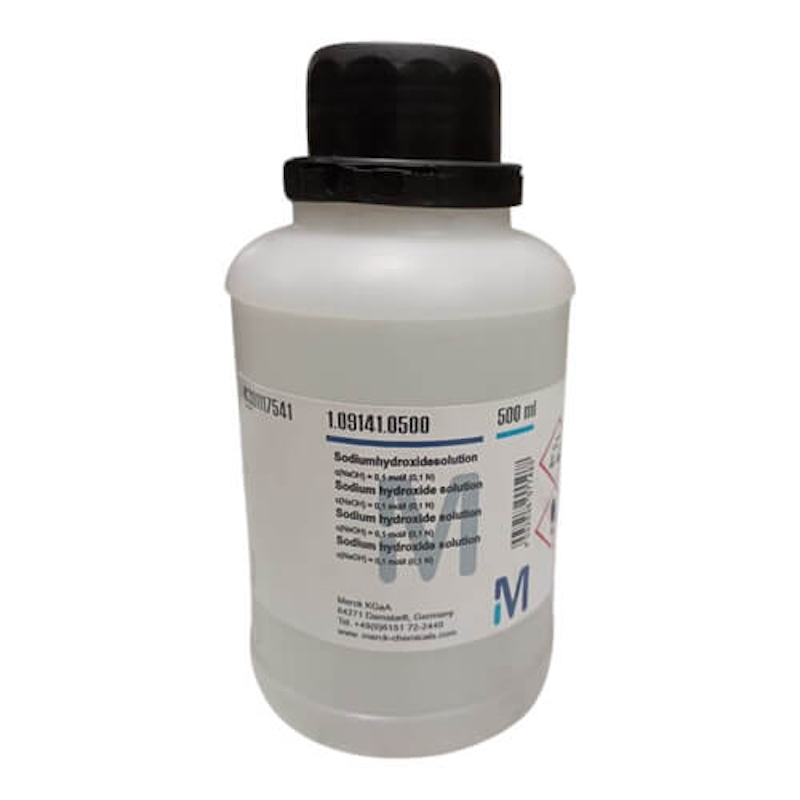
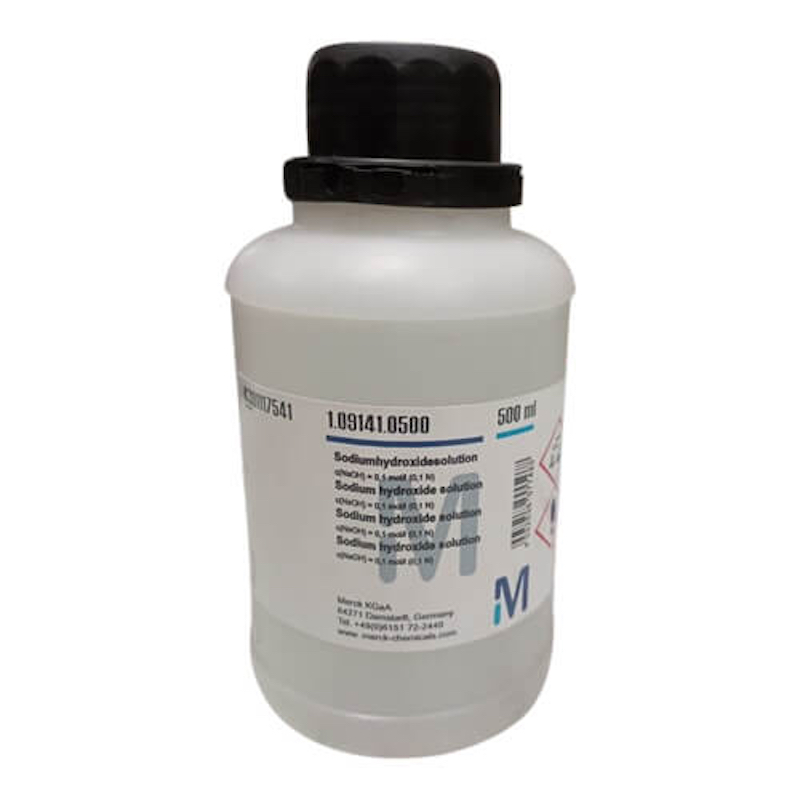
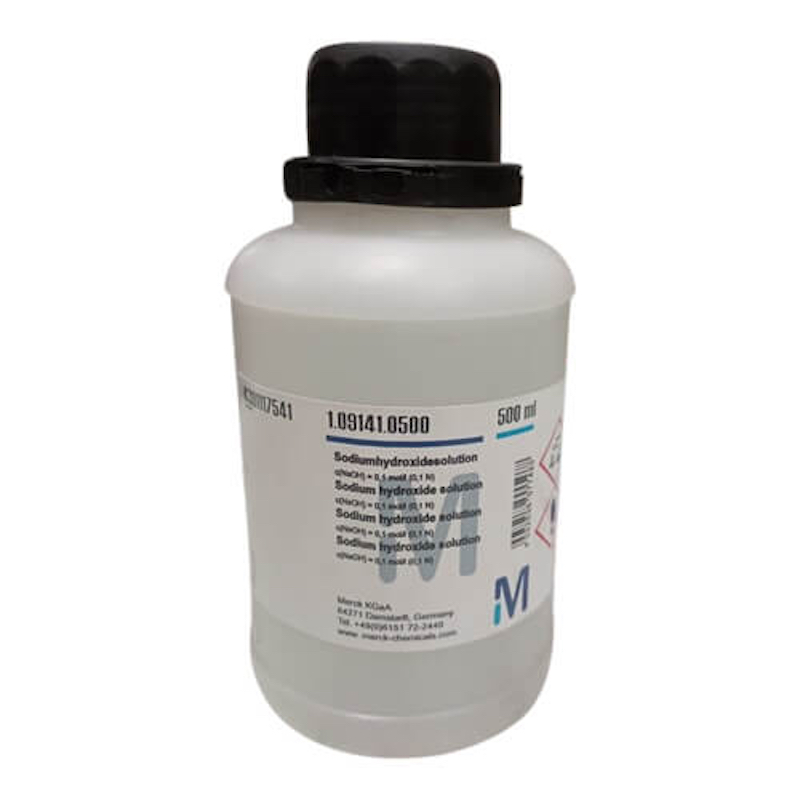
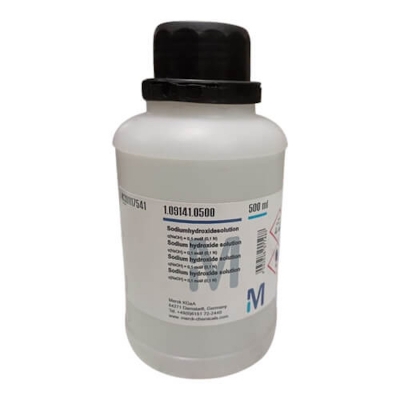
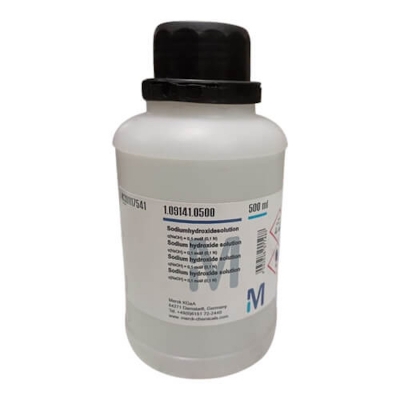
A 0.1N (NaOH) Sodium Hydroxide Solution refers to a normality concentration of 0.1 N for sodium hydroxide in water. Normality (N) is a measure of concentration equivalent to molarity (M), but it takes into account the reactive capacity of the solute. For sodium hydroxide, which is a strong base and dissociates completely in water, 1 mole of NaOH provides 1 equivalent of hydroxide ions (OH⁻). Therefore, the molarity and normality of NaOH are numerically equal.
\n
\n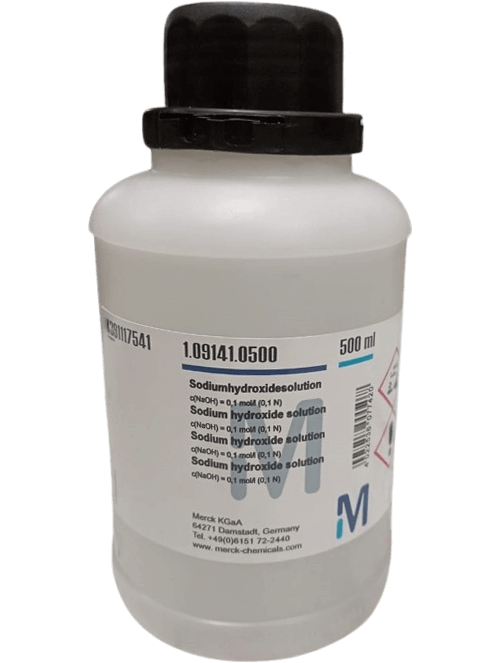 \n
\n
\nConcentration and Preparation of Sodium Hydroxide Solution 0.1N:
\n-
\n
- 0.1 N NaOH means the solution contains 0.1 equivalents of NaOH per liter of solution. \n
- Since 1 N NaOH corresponds to 1 mole of NaOH per liter, a 0.1 N NaOH solution will have 0.1 moles of NaOH per liter. \n
To prepare 0.1 N NaOH:
\n-
\n
- The molecular weight of NaOH: is 40 g/mol. \n
- The amount required for 1 liter of 0.1 N solution:Amount of NaOH (g)=Normality (N)×Equivalent weight of NaOH (g/equiv)×Volume (L)\text{Amount of NaOH (g)} = \text{Normality (N)} \times \text{Equivalent weight of NaOH (g/equiv)} \times \text{Volume (L)}Since 1 mole of NaOH is 1 equivalent (because NaOH dissociates to give 1 OH⁻ ion), the equivalent weight of NaOH is 40 g/eq.So, for 1 liter of a 0.1 N NaOH solution: \n \nAmount of NaOH=0.1×40×1=4 grams of NaOH\text{Amount of NaOH} = 0.1 \times 40 \times 1 = 4 \text{ grams of NaOH} \n
- Steps for preparation:
\n
-
\n
- Weigh 4 grams of solid sodium hydroxide (NaOH). \n
- Add the NaOH to a beaker containing a small amount of distilled water. \n
- Stir the solution carefully to ensure the NaOH dissolves completely (NaOH is highly exothermic when dissolving in water, so do this slowly). \n
- Transfer the solution to a 1-liter volumetric flask, and dilute it with distilled water to the 1-liter mark. \n
- Mix thoroughly. \n
\n
Usage of 0.1 N Sodium Hydroxide Solution:
\nA 0.1 N NaOH solution is commonly used in laboratory settings for: \n-
\n
- Titrations (such as acid-base titrations) to neutralize acids. \n
- Standardization of other solutions. \n
- Buffer solutions: To adjust pH in various chemical reactions and processes. \n
Safety Considerations:
\n-
\n
- Corrosive: NaOH is caustic and can cause severe burns upon contact with skin or eyes. \n
- Handling: Always wear appropriate personal protective equipment (PPE), including gloves, goggles, and a lab coat. \n
- Storage: Store NaOH solution in tightly sealed containers to prevent absorption of CO₂ from the air, which can convert NaOH to sodium carbonate (Na₂CO₃). \n
Note on Normality vs Molarity:
\nFor sodium hydroxide, normality (N) is the same as molarity (M) because each molecule of NaOH provides one hydroxide ion (OH⁻). Therefore, a 0.1 N NaOH solution also has a concentration of 0.1 M NaOH. \n-
\n
- We can’t send the liquid product through a courier service. \n
- এই পণ্যটি কুরিয়ারে পাঠানো হয় না। \n
-
\n
- Sodium Hydroxide Solution \n
- Pack Size: 500mL \n
- c(NaOH) = 0.1 mol/l (0.1 N) \n
- We can’t send the liquid product through a courier service. \n
- এই পণ্যটি কুরিয়ারে পাঠানো হয় না। \n

Customer Questions and answers :
Login to ask a question
