
 Global Finds
  Quick Commerce
  Daily Bazar
  Electronics & Appliances
  Mother, Baby & Toys
  Beauty
  Sports
  Automotive
  Stationery, Books & Music
 _20.png) Fashion Luxe
Fashion Luxe  Fashion
 _20.jpeg) Home
Home  Garden & Pet Care
  Special Weekly Offer
  Grocery
  Global Finds
  Quick Commerce
  Daily Bazar
  Electronics & Appliances
  Mother, Baby & Toys
  Beauty
  Sports
  Automotive
  Stationery, Books & Music
 _20.png) Fashion Luxe
Fashion Luxe  Fashion
 _20.jpeg) Home
Home  Garden & Pet Care
  Special Weekly Offer
  Grocery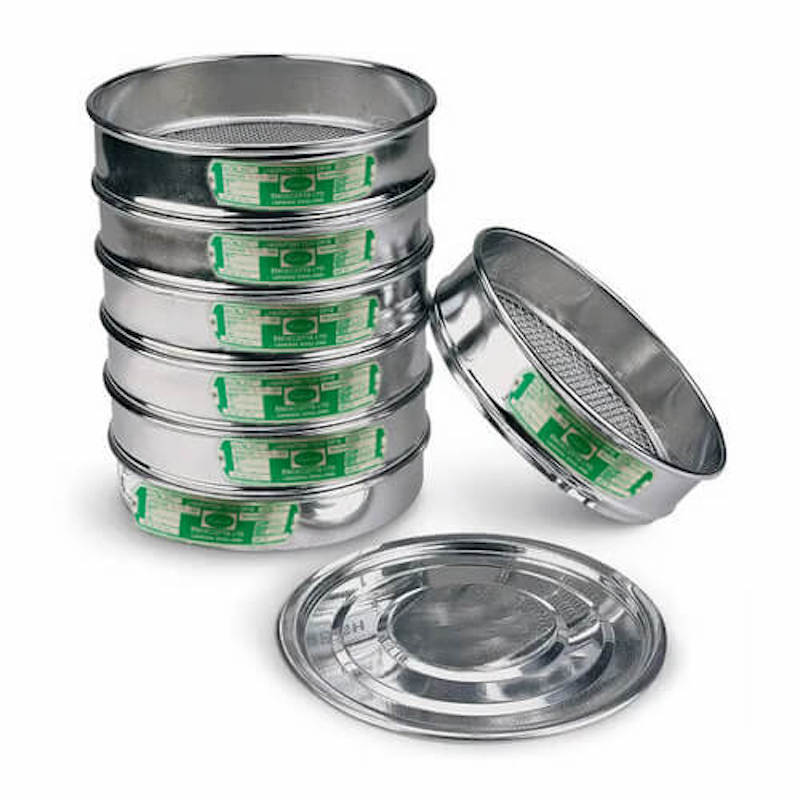
POPULAR SS Frame Test Sieve Set (Diameter = 200mm) - Rigid Design of Minimum Weight – With Uniform Fabrication for smooth-nesting on each other (WITHOUT CALIBRATION CERTIFICATE) (Set of 8 Pcs).
\n \n-
\n
- SET OF 8 PCS. - Set contains 4.75 mm, 2.36 mm, 1.18 mm, 600 Microns, 300 Microns, 150 Microns, 75 Microns, and Lid & Receiver Set \n
- SS FRAME—The frame is made of spun brass without joints and has Stainless Steel mesh for the long life of the product. \n
- UNIFORM FABRICATION - Uniform fabrication allows smooth nesting with each other. \n
- VERSATILITY – Usage in various places including agriculture, biology, chemistry/plastics, construction materials, engineering/electronics, environment/recycling, food, geology/metallurgy, glass/ceramics, medicine/pharmaceuticals, foodstuff industries, concrete industries, coal industries, etc. \n
- Our Test Sieves have been completely designed, fabricated, assembled & strictly quality-checked in Bangladesh. \n
Equipment Needed:
\n-
\n
- Sieve set (200 mm diameter) with standard sieve sizes: 4.75 mm, 2.36 mm, 1.18 mm, 600 µm (0.6 mm), 300 µm (0.3 mm), 150 µm (0.15 mm), 75 µm (0.075 mm), Pan (for bottom catch) \n
- Mesh Size: 4, 8, 15, 30, 50, 100, 200 Mesh \n
- Weighing balance (accurate to at least 0.1 g) \n
- Sample of oven-dried sand (~500g – 1000g) \n
- Sieve shaker (optional but recommended) \n
⚙️ Step-by-Step Procedure:
\n1. Prepare the Sample
\n-
\n
-
\n
Take a representative dry sample of sand (~500g to 1000g).
\n
\n -
\n
Record the total weight (W) of the sample.
\n
\n
2. Stack the Sieves
\n-
\n
-
\n
Arrange the 200 mm sieves in order:
\n \n-
\n
-
\n
Top: 4.75 mm
\n
\n -
\n
Then: 2.36 mm → 1.18 mm → 600 µm → 300 µm → 150 µm → 75 µm
\n
\n -
\n
Bottom: Pan
\n
\n
\n -
\n
3. Sieve the Sample
\n-
\n
-
\n
Place the sand on the top (4.75 mm) sieve.
\n
\n -
\n
Cover and shake for 10–15 minutes using a mechanical shaker (or manually).
\n
\n -
\n
After sieving, carefully collect and weigh the amount retained on each sieve.
\n
\n
4. Record the Weights
\n-
\n
-
\n
Record the individual weight retained on each sieve.
\n
\n -
\n
Calculate the cumulative retained and cumulative % retained for each sieve.
\n
\n
-
\n
- Sieve Set Contains 4.75 mm, 2.36 mm, 1.18 mm, 600 Microns, 300 Microns, 150 Microns, 75 Microns, and Lid-Pan \n
- Mesh Size: 4, 8, 15, 30, 50, 100, 200 Mesh \n
- SS Frame Test Sieve (Diameter = 200mm) \n
- Origin: England, Assemble Bangladesh \n

Login to ask a question
